Commercial & Cultural Intelligence
How the interaction between commercial ambition and cultural perception determines whether brands grow, stall or quietly lose their competitive position.
& Cultural
Intelligence
Most organisations already understand commercial intelligence. Many invest heavily in customer research, market analysis and performance metrics. Others dedicate significant resources to understanding culture, consumer behaviour and emerging trends.
Yet despite this, many brands continue to underperform. Not because they lack creativity. Not because they lack investment. But because they fail to understand how commercial priorities and cultural realities shape one another.
- Sustainable brand performance depends on recognising how commercial objectives and cultural perception interact to influence every brand decision.
- Most organisations treat commercial and cultural intelligence as separate disciplines. The most successful treat them as one.
- In increasingly complex organisations, this is no longer a marketing capability. It is a leadership discipline.
The Assumption That Holds
Many Brands Back
Most organisations assume stronger brands are created through better marketing. When growth slows, they increase media spend. Refresh the identity. Launch another campaign. Rewrite the messaging. Develop a new tagline.
These activities may improve visibility. Some generate short-term commercial success. But few address the underlying reason why brands gain — or lose — their competitive position.
Because brands are not built by communications alone. They are built through thousands of decisions that shape how an organisation is experienced commercially and culturally over time. The campaign is the last five percent. The other ninety-five percent is everything the organisation does before anyone sees an advertisement.
Two Forms of Intelligence
The discipline of brand leadership draws on two distinct forms of intelligence. Most organisations are strong in one. Very few master both. And fewer still understand how they interact.
- Revenue and margins
- Market share and growth
- Customer acquisition costs
- Operational performance
- Pricing power and position
- How people interpret value
- How trust is formed and lost
- Why behaviour changes
- How expectations evolve
- How organisations are experienced within society
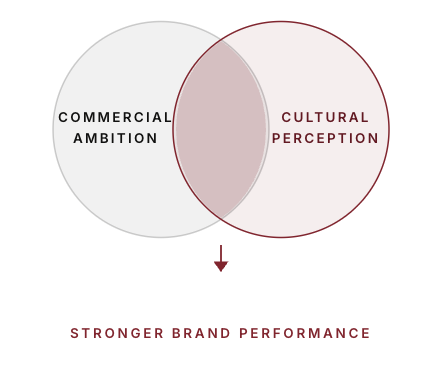
The gap between them is where brand performance is won or lost. An organisation with strong commercial intelligence but weak cultural understanding will make efficient decisions that alienate the people they serve. An organisation with deep cultural sensitivity but poor commercial discipline will produce work that resonates but does not compound.
Brand performance improves when organisations gain a deeper understanding of how their brands are perceived within their commercial and cultural context — not in isolation from one another.
Where Brand Performance
Really Comes From
Brand performance is often measured through awareness, consideration, reputation and preference. These are outcomes, not causes. Performance improves long before customers notice it.
It improves when leadership creates greater alignment between commercial objectives and cultural understanding. When strategy reflects genuine customer realities rather than internal assumptions. When operations consistently reinforce the brand promise. When communication accurately reflects organisational behaviour rather than aspirational positioning disconnected from delivery.
Marketing becomes stronger because the organisation becomes clearer. The external expression improves not because the creative brief improved, but because the thinking behind it did.
One of the privileges of working across multiple continents is that you begin to recognise patterns that are difficult to see from within a single market. The industries change. The products change. The cultures certainly change.
Yet one pattern remains remarkably consistent: the organisations that achieve sustained brand performance are rarely those with the biggest campaigns. They are those whose commercial decisions reflect a deeper understanding of the people they serve.
Commercial & Cultural Intelligence
Commercial & Cultural Intelligence is the discipline of understanding how commercial ambition and cultural perception influence one another — and applying that understanding to improve brand performance.
It asks questions many organisations rarely ask. Not just what do we want to achieve, but how is that ambition perceived by the people we are asking to share it? Not just what does our research tell us, but what do we still not understand about the culture we are entering?
This is not a framework to be applied once and filed. It is a discipline to be practised continuously — in how leadership teams make decisions, how agencies are briefed, how markets are entered, and how organisations listen to the cultures they serve.
Executive Perspectives is a series exploring the relationship between leadership, commercial strategy and brand performance — through observations developed over nearly three decades of international practice across Europe, Africa, Asia and the Middle East.